P.O Box 10, Lyantonde| Tel: +256-2-612244 | E-mail: [email protected], [email protected]

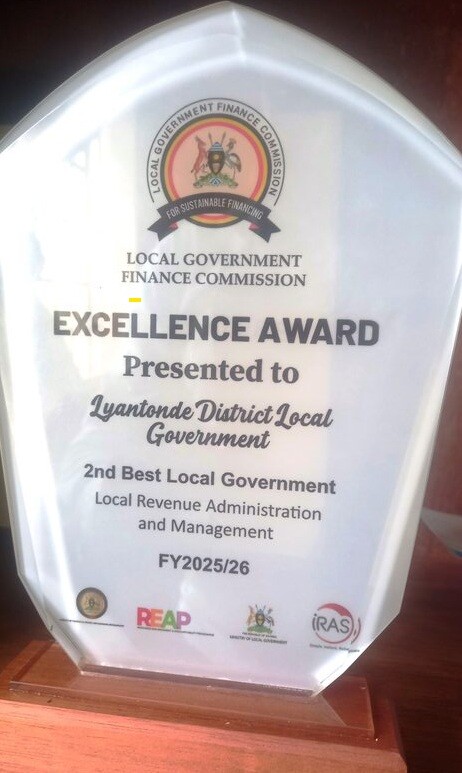
Lyantonde District Ranked Second Best in Uganda for Local Revenue Administration and Management
Lyantonde District Local Government has earned national recognition after emerging as the second-best local government in Uganda in local revenue administration and management, an achievement attributed to improved financial accountability, teamwork and the adoption of digital revenue collection systems.
The recognition by the Local Government Finance Commission (LGFC) marks a significant milestone in the district’s efforts to strengthen local revenue mobilisation, reduce financial leakages and improve its capacity to finance service delivery.
The achievement comes against a background of persistent challenges faced by local governments across Uganda in mobilising adequate locally generated revenue. Many local authorities have historically depended heavily on central government transfers, while manual revenue collection systems have presented challenges related to accountability, transparency and revenue leakages.
For Lyantonde, however, the shift from manual revenue collection to the Integrated Revenue Administration System (IRAS) has transformed the district’s revenue performance.
Local Revenue Nearly Triples in One Financial Year
According to the Lyantonde District Revenue Officer, Moses Assimwe, the district recorded a remarkable increase in locally generated revenue, rising from UGX 260 million in the financial year 2024/2025 to UGX 744 million in 2025/2026.
This represents an increase of UGX 484 million, equivalent to approximately 186 per cent, with the district collecting nearly three times what it had mobilised in the preceding financial year.
Assimwe attributed the achievement to deliberate administrative reforms, stronger supervision of revenue collection and the enforcement of IRAS across lower local governments.
He explained that the digital system has helped address long-standing weaknesses associated with manual cash collection, particularly the practice of spending revenue directly at the point of collection before it is properly accounted for.
“The introduction of IRAS, together with the formation and formalisation of the district revenue committee, was the magic bullet that enabled Lyantonde to emerge second-best local government in the whole country,” Assimwe said.
He noted that the system has strengthened accountability by improving the recording, tracking and reconciliation of revenue collections, thereby making it easier for the district to monitor performance across different revenue sources.
Teamwork and Digital Reforms Drive Success
The Chairperson of the District Revenue Collection Committee, Male Paul Kyateeka, described the recognition as a collective achievement resulting from teamwork, commitment and the willingness of lower local governments to embrace modern revenue collection methods.
Kyateeka said the district had previously struggled to realise its full revenue potential because several lower local governments continued to rely on manual collection methods.
“We had been struggling with revenue collection mainly because our teams in the lower local governments were still stuck with manual collection. However, once they embraced IRAS, our revenue nearly tripled,” Kyateeka said.
He commended the district political leadership, technical staff, revenue committee members and lower local government officials for embracing reforms that have strengthened the district’s financial performance.
The Integrated Revenue Administration System is an electronic platform used to support the assessment, billing, payment, monitoring and reporting of local government revenue by reducing reliance on physical cash handling, the system helps improve transparency, strengthen accountability and minimise opportunities for revenue leakage.
District Targets Further Growth in Revenue Collection
Looking ahead, Assimwe expressed optimism that Lyantonde District could register even greater improvements in the financial year 2026/2027.
He revealed that the district is strengthening its revenue administration through the identification, registration and formalisation of taxable properties, alongside measures to improve property-related revenue collection.
The district is also pursuing the approval and implementation of a local revenue charging policy to provide a clearer framework for assessing and collecting revenue from eligible sources.
According to Assimwe, these interventions will help close existing revenue collection gaps, expand the district’s revenue base and improve compliance among taxpayers.
He expressed confidence that the ongoing reforms could enable Lyantonde to surpass its local revenue target for the financial year 2026/2027.
District Leadership Eyes Greater Financial Independence
The Chief Finance Officer of Lyantonde District, Edward Nabende, pledged continued technical and institutional support to the District Revenue Collection Committee to consolidate the gains already registered.
Nabende emphasised the importance of strengthening locally generated revenue to enable the district to finance more of its development and service delivery priorities without excessive dependence on central government transfers.
He noted that improving revenue administration was not simply about increasing collections but also about building a financially sustainable local government capable of responding effectively to community needs.
The Chief Administrative Officer, Peter N. Ruhweeza, applauded the revenue committee, revenue officer and other stakeholders for the outstanding performance.
He challenged the team to build on the achievement and work towards making Lyantonde the leading local government in Uganda in revenue administration and management.
Ruhweeza further set an ambitious long-term goal of increasing locally generated revenue to a level capable of financing at least 50 per cent of the district’s budget.
He stressed that greater financial independence would provide the district with more flexibility to address local priorities, improve service delivery and support development initiatives.
Finance Commission Calls for Accountability in Revenue Utilisation
The recognition comes at a time when the Local Government Finance Commission is emphasising the need for local governments to strengthen both revenue mobilisation and prudent utilisation of public resources.
According to the Commission’s Vice Chairperson, Mariam Nalubega, findings from a survey conducted by the Commission revealed significant differences in how local governments collect, manage and utilise locally generated revenue.
BY; WILSON KUTAMBA- Communications Officer, Lyantonde District Local Government.
Thursday, October 22, 2026